
Home → Journal → Children's healthcare
Children's healthcare
Ticks in Cyprus: What the Risks Are and What to Do If Your Child Is Bitten
How to remove a tick, what to watch for afterwards and why the risks in Cyprus are not quite the same as in Central and Northern Europe
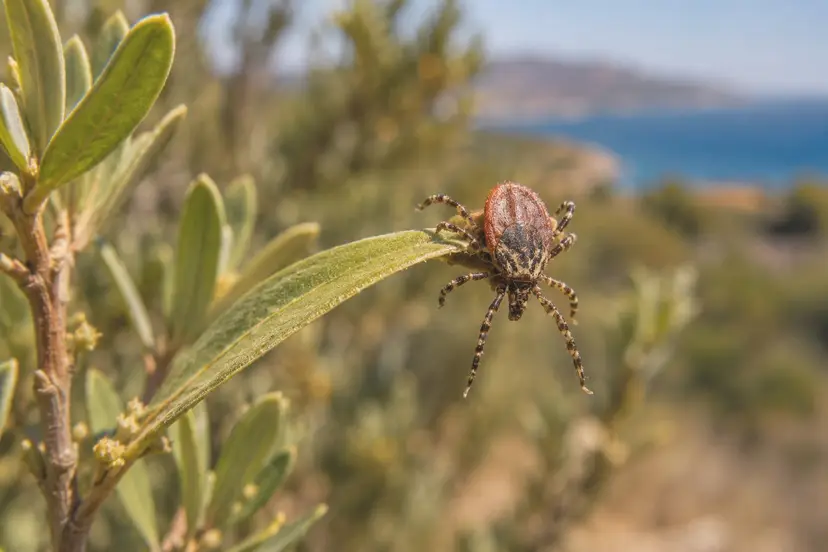
There are ticks in Cyprus. They are found in long grass and scrub, in rural areas, around grazing animals and even in gardens close to natural areas. But if you come from a country where the word “tick” immediately means Lyme disease or tick borne encephalitis, there is one useful thing to know from the start: the pattern of tick related infections in Cyprus is somewhat different.
We will come to those risks in a moment. First, the situation parents are usually rather more interested in when it actually happens: there is a tick attached to your child. What now?
You found a tick on your child. What should you do?
Do not wait for it to drop off by itself. It is better to remove the tick as soon as possible. Use clean, fine tipped tweezers, grip the tick as close to the skin as you can and pull steadily upwards with even pressure. Do not twist it or jerk it out.
After removal, wash the bite area and your hands with soap and water, or clean the skin with an antiseptic. Then check the rest of the child carefully. Finding one tick does not mean it arrived alone. Pay particular attention to the hair and scalp, behind the ears, the neck, armpits, waist, groin and behind the knees.
What not to do
Do not try to persuade the tick to detach with oil, petroleum jelly, cream, alcohol, nail polish or essential oils. And do not try to burn it off. It is, after all, still attached to your child, so burning the tick separately presents a fairly obvious technical difficulty. The child will remember...
The simplest recommended method is careful mechanical removal with tweezers.
What if part of the tick stays in the skin?
It happens. Sometimes a small part of the tick’s mouthparts remains in the skin after removal. There is no need to attack the spot with a needle or start digging at the skin in an attempt to remove every visible speck. If the remaining part cannot be grasped easily with tweezers, leave the skin alone and, if necessary, show the bite to a doctor.
What to do after removing the tick
Write down the date of the bite and where it happened, for example on a walk in Troodos, during a picnic near Paphos or in your own garden. Take a photograph of the bite on your phone as well. If the skin changes over the following days, the picture gives you something useful to compare it with and may help the doctor.
After that, there is no need to spend the next few weeks searching your child for symptoms of every tick borne infection known to medicine. Just keep an eye on how they are feeling. If they develop a fever, an unusual or spreading rash, a severe headache, marked weakness or become noticeably unwell during the following days or weeks, contact a doctor and make sure you mention the recent tick bite. Which tests or treatment are appropriate in an individual case is for the doctor to decide.
Should you keep the tick?
For parents, it is generally more useful to keep the information about the bite than the tick itself: when it happened and where. Testing a removed tick cannot tell you whether the child will become ill. Even finding a microorganism in the tick does not mean it was transmitted to the person.
So after removal, the important thing is not arranging a laboratory career for the tick. It is watching the child. Which brings us to the next question: what exactly are we watching for in Cyprus?
What are the tick risks in Cyprus?
If you grew up in Russia, the Baltic states or Central Europe, seeing a tick may immediately bring one of two things to mind: Lyme disease or tick borne encephalitis. Cyprus has a different epidemiological picture.
Several tick species have been identified here, along with different infectious organisms. Among the better documented findings in Cyprus are spotted fever group Rickettsiae.
What are Rickettsiae?
Rickettsiae are bacteria, some species of which can be transmitted to people through the bite of an infected tick. In one large study in Cyprus, researchers examined 3,950 ticks collected from goats, sheep, cattle, dogs, foxes, hares and mouflon. Rickettsial DNA was found in 315 of them.
That does not mean that eight per cent of all ticks a family might encounter in Cyprus today are infectious to humans. The research was conducted many years ago, the ticks were collected from animals, and detecting an organism in a tick does not prove that it will be transmitted to a person. The useful conclusion for parents is much simpler: Rickettsiae are genuinely present in Cyprus and this has been documented in research.
Mediterranean spotted fever
One of the better known infections in this group around the Mediterranean is Mediterranean spotted fever, and it occurs in Cyprus. Possible symptoms include high fever, headache, muscle pain and a rash. Sometimes a characteristic dark crust appears at the site of the bite, known medically as an eschar or tache noire.
The person may never have noticed the tick bite itself. So if a child develops a fever and rash several days after spending time outdoors, tell the doctor not only about the symptoms but also where the child has recently been and whether tick exposure was possible.
Parents absolutely do not need to memorise the names of Rickettsiae. The date of a possible bite and a photograph of the site are likely to be considerably more useful to the doctor than a parent arriving with newly acquired expertise in Latin.
What about tick borne encephalitis?
This is where the picture is more reassuring. Cyprus is not considered a usual endemic area for tick borne encephalitis, or TBE. The main European risk areas are elsewhere, so finding a tick on a child in Cyprus does not imply the same TBE risk as a bite in, for example, the Baltic states or certain parts of Central Europe.
Living in Cyprus alone is also not a reason to vaccinate a child against TBE. Geography matters, however. If your family is travelling to an area where TBE is established, discuss vaccination with a doctor before the trip.
And Lyme disease?
Here too, it is important not to import the risk picture from other parts of Europe. The main European vector of Lyme borreliosis is Ixodes ricinus, and Cyprus is not regarded as one of Europe’s classic high risk areas for Lyme disease.
That does not mean Lyme disease is impossible in Cyprus. Data are relatively limited, and cases of Lyme borreliosis have been described in the scientific literature. So where the bite happened matters, but geography should not be used by parents to rule out a diagnosis themselves. If a child sees a doctor after a tick bite, say exactly where it occurred. If the tick was found after a trip abroad, give the country and region as well.
What about Crimean Congo haemorrhagic fever?
The name has the unfortunate quality of making staying indoors for the rest of the year sound quite reasonable. For Cyprus, however, it is important to distinguish between biological possibility and the actual epidemiological situation.
Hyalomma marginatum, one of the tick species capable of carrying the virus that causes Crimean Congo haemorrhagic fever, or CCHF, has been found in Cyprus. But the presence of a potential vector does not mean the disease is circulating among people.
According to the ECDC monitoring information used for the checked original article, as of 26 August 2026 Cyprus was not among the EU or EEA territories reporting locally acquired CCHF cases in 2026. There is therefore no current reason to make this disease the central fear of an ordinary family walk in Cyprus.
What parents actually need to remember
Not the Latin names of ticks and certainly not a catalogue of infections. The useful point is simply that ticks exist in Cyprus, but the local pattern of tick borne disease differs from Central and Northern Europe.
After a bite, you do not need to work out which infection might theoretically have been transmitted. Remove the tick, record the date and location, photograph the skin and watch how the child feels. The next question is which changes are actually worth paying attention to.
What to watch for after a bite
The tick is out, you have taken a photograph and written down the date. In most cases, the next step is simply to observe the child rather than turning the following few weeks into a daily medical inspection.
A small area of redness immediately after removal does not by itself mean infection. The skin can react to both the bite and the removal. Contact a doctor if, during the following days or weeks, the child develops a fever, an unusual or spreading rash, severe headache, marked weakness, muscle pain or is clearly becoming unwell. In Cyprus, the combination of fever and rash after recent time outdoors is particularly worth mentioning.
And tell the doctor plainly: “There was a recent tick bite.” Do not try to decide from internet searches which infection the child has, which tests are needed or whether treatment should be started. That part belongs to the doctor.
Where can a child pick up a tick in Cyprus?
You do not need to disappear into deep forest to find one. Ticks occur in long grass, scrub, rural areas, around grazing land and in places frequented by animals. They have been collected from goats, sheep, dogs, cattle, foxes, hares and Cyprus mouflon, so a perfectly ordinary scenario might be a mountain walk, a picnic, a path through overgrown vegetation or playing in a garden beside a natural area.
And no, ticks do not sit on tree branches waiting for a suitable child to pass underneath so they can make a dramatic entrance. They do not jump and they do not fly. They usually reach people after contact with grass or low vegetation.
How to check a child after a walk
After walking through long grass or scrub, give the child a quick check. Look carefully at the scalp and hairline, behind the ears, neck, armpits, waist, groin and behind the knees. Ticks can be particularly easy to miss in children’s hair.
Check clothing and backpacks too. If the dog came with you, check the dog. A tick can travel home on clothing or an animal and attach later, which is a rather more efficient return journey than anyone invited it to make.
How to reduce the risk
For walks through higher vegetation, use closed shoes and clothing that reduces exposed skin. An age appropriate tick repellent can also be used according to the manufacturer’s instructions. When you get home, check the child.
If you have a dog or cat, regular veterinary tick prevention is also worth arranging. For an ordinary family walk, there is no need to turn preparation into an expedition to an infectious disease zone.
The main thing to remember
Ticks exist in Cyprus. Finding one attached to your child does not mean the child has caught anything. Remove it carefully with tweezers, photograph the bite, record when and where it happened and watch how the child feels.
If a fever, unusual rash or significant illness develops later, contact a doctor and mention the bite. If the child is seriously unwell, call 112.
Everything else, including diagnoses, investigations and treatment, can stay with the doctors. They do, after all, have rather more grounds for making those decisions than parents, Google and the kids.cy editorial team combined.
Questions and answers
- How do we remove a tick from a child correctly?
- With clean, fine-tipped tweezers: grip the tick as close to the skin as possible and pull upwards smoothly with steady pressure, without twisting or jerking. Afterwards wash the bite and your hands with soap or use an antiseptic, then check the child all over — hair, behind the ears, neck, armpits, waist, groin and behind the knees.
- Can we cover the tick in oil so that it drops off by itself?
- No. Neither oil nor petroleum jelly, cream, alcohol, nail varnish or essential oils help, and there is no need to burn it off either — it is attached to your child. Waiting for the tick to drop off on its own is not worth it: the sooner it is removed, the better.
- Is tick-borne encephalitis a danger in Cyprus?
- Cyprus is not among the usual endemic areas for tick-borne encephalitis. The main European risk areas are elsewhere in Europe, so a tick found on a child here does not carry the same risk as in the Baltic states or Central Europe. The local risks are of a different kind.
- Where can a child pick up a tick?
- Not necessarily in a forest. Ticks are found in tall grass and scrub, in the countryside, near grazing land and wherever animals are about — they have been found on goats, sheep, dogs, cattle, foxes, hares and Cyprus mouflon.
- What should we watch for after a bite?
- Simply observe, without turning the following weeks into a daily medical examination. Slight redness immediately after removal does not in itself mean infection: skin reacts both to the bite and to the removal. It is worth photographing the bite site and noting the date.
Written by the kids.cy editorial team. Reproduction of our content is permitted only with an active link to kids.cy.
Paediatricians
Read next
 Days out and leisure
Christmas Workshops for Kids in Cyprus 2026
Gingerbread houses, handmade decorations, colourful candles and a little creative chaos. This Christmas, children across Cyprus can make their own festive treasures, and parents are welcome to join the fun.
18 November 2026
 News
kids.cy Becomes Official Media Partner of Cyprus’ First Eco Olympiad
Children and teenagers aged 7 to 18 are invited to take part in a new environmental initiative that goes beyond traditional academic competitions. Participation is free.
13 November 2026
 Days out and leisure
Christmas Villages in Cyprus 2026–2027
Nine official Christmas Villages open across Cyprus for the 2026–2027 festive season. Expect local food, handmade gifts, workshops and seasonal performances, with different activities in each village.
10 November 2026