
Living in Cyprus
Cyprus: how do you get from A to B?
Why taxis in Cyprus are found through your contacts rather than an app, what a journey costs, where the bus will take you and what car sharing offers a family without a second car.
 One Cyprus.
Many routes.Real life. Real distances.
In London, you have Uber. In Moscow, Yandex. In Cyprus, you have Andreas.

Andreas need not actually be called Andreas. He might be Costas, or Michalis, or a man you saved in your phone as TAXI PAPHOS a few years ago. What matters is that he once got you where you were going without any fuss, and his number has been kept ever since, rather as one keeps the number of a good plumber.
In most big cities, you find a taxi through an app. In Cyprus, people still quite often simply ask:
“Have you got a taxi driver’s number?”
“I have.”
But having the number is not the same as having a car. Andreas might turn up in an hour, pass you a colleague’s number or simply not answer.
Why is Andreas such a scarce resource in the first place?
For a car to work as a taxi, it needs a special licence, and the number of licences is limited.
In 2002 the government decided to increase the number of urban taxis. More than 600 taxi drivers went on strike, arguing that the market was already overcrowded. The authorities received 1,066 applications and in the end approved 250 new licences.
After that, the ordinary issuing of new urban taxi licences all but stopped for more than twenty years. In that time the population of Cyprus grew, the stream of tourists swelled, and smartphones and apps arrived. The supply of taxis, meanwhile, barely changed.
The shortage became so acute that licences changed hands on the secondary market for tens of thousands of euros. Reports on the current reform mention sums of up to €100,000. And that is only the right to use a car as a taxi. The car itself is not included.
The authorities are now preparing a new licensing model that should allow the number of taxis to grow gradually.
is what a taxi licence could fetch on the secondary market. And that is only the right, without the car.
Apps have not solved the problem yet. You can book a taxi through them in Cyprus, but behind the wheel there will still be a licensed driver in a licensed car. Here you cannot simply register your own car with a service and start taking fares in the evening, as you can in some other countries.
An app helps you find Andreas. It just doesn’t make any more Andreases.
And how much does Andreas cost?
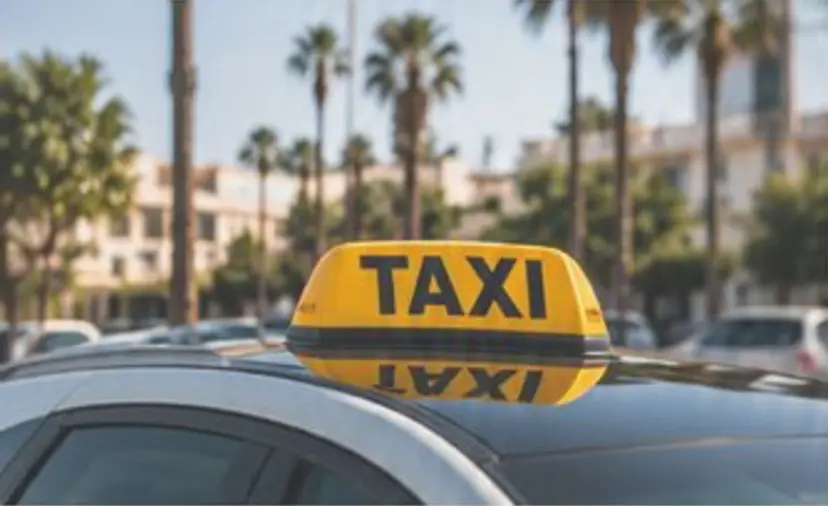
In Cyprus it is best to arrange a taxi in advance. You say where you need picking up and what time you need to leave. What comes back may not be “I’ll be there at 18:00” but something more like “somewhere between 17:45 and 18:15”.
The price has a Cypriot quirk of its own. Officially, urban taxis are meant to run on a meter, with fares set by the state. In practice, the driver quite often just tells you what the journey will cost before you set off.
Which is why a good taxi driver you know is worth having here for more than his knowledge of the roads. You already have a fair idea of when he will turn up, what he will ask and whether he will answer the phone at all.
And what about buses?
The bus network covers the main parts of the towns, and on some routes the buses run fairly often. If you regularly travel the same route and the timetable suits you, the bus may do the job perfectly well.
It gets harder when you need to reach several different places in a day. Work, school, the doctor, a child’s training session. Add the changes and the walk to the stop, and in summer the Cypriot heat as well. Fifteen minutes on foot in August is not at all the same as fifteen minutes in February.

A car without a car
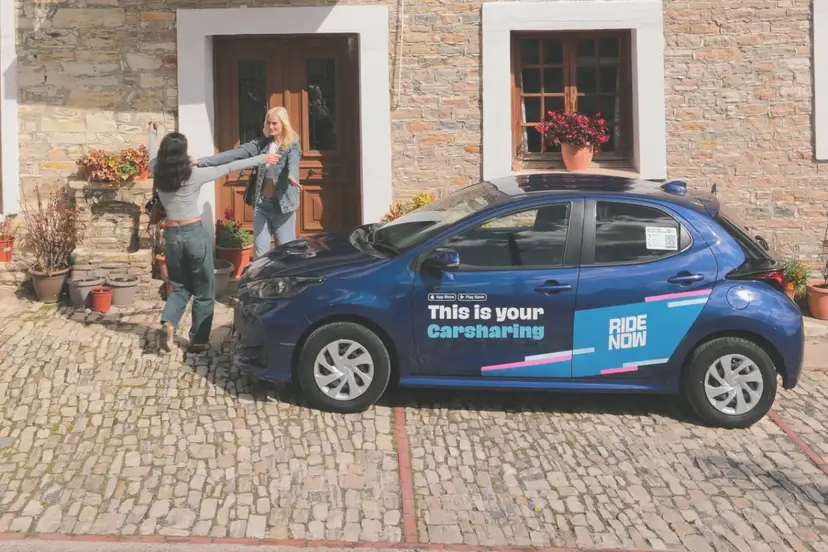
But you need not buy a car of your own. Cyprus has a car-sharing service, RideNow. You find a free car in the app, book it, unlock it with your phone and off you go. There are cars in Paphos, Limassol, Larnaca and Nicosia, as well as at the airports, and you can drive them between towns too.
For a family, car sharing is particularly interesting as an alternative to a second car. If you need a second car only a few times a week, there is no need to buy one and pay for insurance, servicing and road tax all year round.
You still need a car. It just doesn’t have to be yours.
When your child can manage on their own. In theory.
There is one more consequence of Cyprus’s dependence on the car, and you notice it most once the children are older.
A child no longer needs taking to training, to friends’ houses or to the cinema. They are perfectly capable of getting there on their own. But if the place is eight kilometres away, there is no suitable bus and it is too far to walk, independence ends with a question:
“Dad, can you give me a lift?”
So the age at which children start getting about town on their own is not always a matter of age in Cyprus. Sometimes it is a matter of the bus route.
Nearby, if you go by car
Cyprus changes your sense of distance rather quickly. Seven kilometres by car is nearby. Seven kilometres on foot is a long way. Seven kilometres by bus depends on the route, the time of day and how kindly the timetable happens to line up today.
When you have a car, you notice none of this. You simply get in and go.
And then one day it stays in at the garage. You open the map. The place you need is 7.2 kilometres away.
Written by the kids.cy editorial team. Reproduction of our content is permitted only with an active link to kids.cy.