
Education
From Monastery School to International School: Why Cyprus Has So Many Different Private Schools
Almost 400 years of history behind the education choices families see today
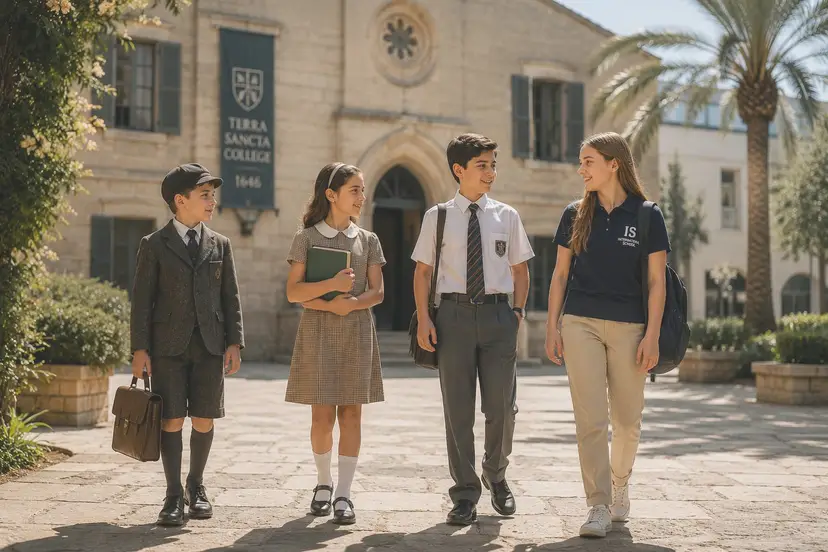
Parents in Cyprus can choose between British, American, international and Cypriot schools. At first glance, it is easy to assume that this extraordinary mixture is a fairly recent development. It isn’t. The education map of Cyprus has been building itself for almost 400 years.
Each new era brought another educational tradition to Cyprus, but almost never managed to remove the ones already here. The result is that schools founded by Franciscan friars, British educators, American missionaries and modern international education groups now operate side by side. That is why the words “private school” tell you surprisingly little in Cyprus: behind them can be completely different histories, curricula and ideas about what a school is supposed to do. So before trying to understand today’s bewildering choice, it helps to go back to the beginning.
1646: where the story of private education in Cyprus begins
The history of private schools in Cyprus begins long before the British arrived. In 1646, while Cyprus was under Ottoman rule, Franciscan friars opened Terra Santa in Nicosia. It is regarded today as the oldest school in Cyprus still in operation, but it began as a very small primary school. A boarding section came later, bringing children not only from Nicosia but from other parts of Cyprus and from abroad.
Secondary education arrived much later. It was not until 1913, during the period of British administration, that the school was allowed to open a gymnasium and lyceum. Which produces a rather wonderful piece of perspective: by the time the first English language school opened in Cyprus, Terra Santa had already been educating children for more than two and a half centuries.
And almost four centuries after it opened, it is still here.
1900: the first English language school in Cyprus
The next chapter begins after Cyprus came under British administration. In 1900, Anglican clergyman Canon Frank Darvall Newham founded The English School in Nicosia. The first school year involved just 12 or 13 pupils, with lessons held in an ordinary rented house on Victoria Street inside the old city. Not exactly the grand campus brochure version of school history.
The English School became the first school in Cyprus where English was the main language of instruction, and it grew quickly. By 1906 there were around 40 pupils, and by 1910 more than 80, including boarders. In 1962 it became coeducational after merging with The English School for Girls.
But its influence wandered rather decisively beyond the classroom. According to the school archives, pupils from The English School played the first football match in Cyprus, while Newham also introduced cricket and hockey. So one small school managed to become part of the history of both modern education and modern sport in Cyprus. Quite efficient, really.
1908: the American educational tradition arrives
Only eight years after The English School opened, another educational tradition appeared. In 1908, the McCarrolls, missionaries from the Reformed Presbyterian Church of North America, opened the American Academy in Larnaca. They had previously run a small primary school and later received permission to establish a secondary school for boys. Within a year, around 60 children were studying there.
The school’s original purpose was very much of its time: to combine academic education with Christian upbringing. Over the years, however, the American Academy changed along with Cyprus itself. Its pupils came from the Greek Cypriot, Turkish Cypriot, Armenian and Maronite communities, and later from families arriving from many other countries. Today, American Academy remains one of Larnaca’s best known schools.
Why those three schools still matter
Put Terra Santa, The English School and American Academy next to one another and the modern school system in Cyprus suddenly makes much more sense. They were founded in different centuries, by different people and for completely different reasons. Terra Santa grew out of the Catholic Franciscan tradition, The English School belongs to the British chapter of Cyprus’s history, and American Academy brought an American educational tradition.
None of them replaced the school that came before it. Each simply added another layer.
What this means for parents
The variety of private schools in Cyprus can look like a modern international phenomenon. In fact, it has been accumulating for nearly four centuries. New traditions kept arriving, while the old ones stubbornly refused to disappear. That is how one relatively small country ended up with schools carrying remarkably different histories, cultures and curricula.
The 1960s and 1970s: the schools we recognise today begin to appear
After independence in 1960, private education in Cyprus began to look more like the sector parents recognise today. The earliest schools had been closely connected with churches, British administration or missionary organisations. Now schools began appearing primarily as modern private educational institutions, and the present day private school landscape really started to take shape.
The Grammar School: two education systems under one roof
The Grammar School opened in Nicosia in 1963 and was among the early schools to offer an unusual combination for the time. Students could work towards the Cypriot Apolytirion while also preparing for British IGCSE and GCE examinations. Today, that sort of combination barely raises an eyebrow. At the time, it was a new idea.
The school demonstrated something that would later become very Cypriot indeed: different education systems do not merely have to coexist in the same country. They can coexist inside the same school.
Foley’s School: a school history shaped by displacement
In 1970, Ward and Pat Foley opened Famagusta Grammar School in Famagusta. By 1974, it had around 200 pupils. Then events changed the school completely. Following the Turkish invasion, the Foley family and their pupils were forced to leave Famagusta. For several months there was still hope that they might return, but eventually it became clear that the school could no longer operate in its original home.
Instead of closing, it started again in Limassol and later took the name Foley’s School, by which it is known today. Its story is a particularly clear reminder that the history of education in Cyprus has never existed separately from the history of Cyprus itself.
Then the new schools start arriving one after another
By the early 1970s, private education was expanding quickly. Logos School opened in Limassol in 1973 with just 13 pupils near the old port, Falcon School followed in Nicosia in 1976, and PASCAL opened in 1978.
Each brought something different, and none made the existing schools obsolete. By the end of the 1970s, English language private education was no longer the story of a handful of old institutions. Cyprus had a proper private education sector.
1987: when international schools became genuinely international
There is one year that stands out particularly clearly: 1987. Several schools opened that year which are now familiar to many families moving to Cyprus.
The International School of Paphos
The International School of Paphos opened in 1987 as a small coeducational day school and grew with Paphos itself. The school later moved to a large campus in Anavargos and today reports more than 1,000 students representing over 40 nationalities. Like many large schools, it turns out to have begun by being considerably smaller.
The Heritage Private School
The Heritage Private School opened in Limassol in the same year. Today it is one of the city’s largest schools, but its first academic year was slightly less crowded: six pupils. Every large campus has to start somewhere. Apparently six children will do.
American International School in Cyprus
Another well known school appeared in Nicosia in 1987. The future American International School in Cyprus, or AISC, opened with 51 students and, according to the school, its creation was connected with a request from the US Embassy. It was later acquired by the education group ESOL Education, and in 1994 the school introduced the International Baccalaureate programme.
Cyprus now had another educational tradition sitting alongside the British, Cypriot and other international routes. The collection was becoming impressive.
Why the late twentieth century changed everything
By this point, Cyprus already had schools with very different origins: old religious schools, schools rooted in the British period and modern private schools founded after independence. Now came genuinely international schools, educating children from dozens of nationalities and sending graduates to universities around the world.
What this means for parents
This is the period in which the modern idea of an International School, the kind many families search for after moving to Cyprus, really took shape. But once again, it did not replace what was already here. It simply became another layer in a system that was already more than 300 years old.
Why does small Cyprus have so many different school systems?
By now, the answer is probably becoming clear. When parents first start looking at schools in Cyprus, the variety can be genuinely surprising. Surely one private school should be broadly similar to another? Not here.
Behind the label “private school” can sit completely different educational traditions. Some schools grew out of the British system, others retain the Cypriot curriculum, some follow an American model, others build their programmes around the International Baccalaureate, and some combine several routes at once.
According to the Cyprus Ministry of Education, private schools are officially divided into categories according to how closely their curricula correspond to those of state schools. So two institutions both legally described as private schools can offer children very different educational journeys.
What this means for parents
Do not choose by the words International, British or American on the sign outside. Those words may be useful clues, but the curriculum matters much more. Find out what your child will actually study, which examinations they will sit and which qualification they will leave with.
From Apolytirion to IGCSE, A Levels and IB
The history also explains another feature of education in Cyprus: new programmes have rarely pushed the old ones out. That is why families now encounter so many different routes. Some schools prepare students for the Cypriot Apolytirion, others build their secondary programme around IGCSEs and A Levels, American schools use their own educational route, while some also offer the International Baccalaureate. Other schools combine several systems.
There is therefore no useful answer to the question “Which system is best?” Each opens different routes to universities in different countries.
What this means for parents
Start with where your child is most likely to continue their education after school. Then compare curricula and examinations. Doing it the other way round is a little like buying a ticket first and deciding where you wanted to go afterwards.
We explain the different qualifications in our separate guide: “School Qualifications in Cyprus: IGCSE, A Levels, IB, Apolytirion and Where They Can Take You.”
Almost 400 years later
The history of private education in Cyprus explains the modern school landscape remarkably well. In 1646, Franciscan friars opened a small school in Nicosia. In 1900, The English School began with a dozen pupils in a rented house. Logos School once opened for just 13 children, The Heritage Private School began with six, and The International School of Paphos was once a small local school too. Today, many of these institutions have become large campuses educating hundreds or even thousands of children from dozens of nationalities.
But the most interesting change is not what happened to the individual schools. It is what happened to the education map of Cyprus. Every era brought new ideas, new programmes and new schools, while almost nothing that came before disappeared.
That is why families today can choose between British, Cypriot, American and international education routes. Not because one finally defeated all the others. Because Cyprus kept the whole collection.
Every school mentioned here is in the catalogue: private schools in Cyprus — 54.
In short
The history of private education in Cyprus begins in 1646 with Terra Santa.
British, American and international educational traditions arrived in Cyprus at different points in its history.
New schools and programmes generally added to what already existed rather than replacing it.
That is why Cyprus has an unusually wide choice of education systems for a country of its size.
When choosing a school, the curriculum, final qualification and university routes matter more than the name on the gate.
Questions and answers
What is the oldest private school in Cyprus?
Terra Santa College in Nicosia. It was founded by Franciscan friars in 1646 and is regarded as the oldest school in Cyprus still in operation.
What was the first English language school in Cyprus?
The English School in Nicosia, founded in 1900. It was the first school in Cyprus where English was the main language of instruction.
When did modern international schools appear?
Many of the schools now described as international schools appeared in the second half of the twentieth century. The sector expanded particularly quickly from the 1960s through the 1980s.
Do all private schools in Cyprus follow the British curriculum?
No. Cyprus has schools offering British, American, Cypriot and international programmes, and some combine more than one education system.
What matters more when choosing a school: its name or its curriculum?
The curriculum. It determines which examinations your child will take, which qualification they will receive and which university routes will be open afterwards.
Sources
All information in this article was rechecked on 31 August 2026 against official sources.
The article was prepared using:
the official websites of Terra Santa College, The English School, American Academy Larnaca, The Grammar School, Foley’s School, The International School of Paphos, The Heritage Private School and American International School in Cyprus;
materials from the Ministry of Education, Sport and Youth of the Republic of Cyprus on private education.
Checked: 31 August 2026 against official sources of the Republic of Cyprus.
Written by the kids.cy editorial team. Reproduction of our content is permitted only with an active link to kids.cy.
Private schools
Read next
 Days out and leisure
Christmas Workshops for Kids in Cyprus 2026
Gingerbread houses, handmade decorations, colourful candles and a little creative chaos. This Christmas, children across Cyprus can make their own festive treasures, and parents are welcome to join the fun.
18 November 2026
 News
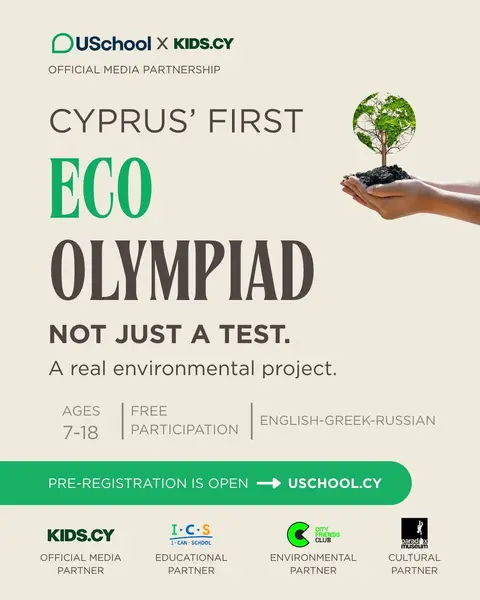
kids.cy Becomes Official Media Partner of Cyprus’ First Eco Olympiad
Children and teenagers aged 7 to 18 are invited to take part in a new environmental initiative that goes beyond traditional academic competitions. Participation is free.
13 November 2026
 Days out and leisure
Christmas Villages in Cyprus 2026–2027
Nine official Christmas Villages open across Cyprus for the 2026–2027 festive season. Expect local food, handmade gifts, workshops and seasonal performances, with different activities in each village.
10 November 2026